
How to Handle an Emergency Truck Repair as an Owner-Operator
Last Updated: November 19, 2026
Quick Summary
For an emergency truck repair, first get the truck off the travel lanes if you can, turn on your hazard lights, and set out warning triangles while staying clear of traffic. Then gather your exact location, truck details, and symptoms before you call a provider. Good preparation makes the repair faster and safer.
Set warning triangles behind the truck before you touch the engine or check anything.
Have your exact location, mile marker, truck make and model, and symptoms ready before calling.
Ask for an itemized estimate in writing that separates service call, diagnosis, labor, and parts.
Confirm the provider carries commercial auto and liability insurance and names the dispatched technician.
Keep every invoice, the written estimate, and photos of the failed part for records and claims.
Stranded with a broken truck?
Big Rig Repair provides 24/7 certified diagnostics and roadside service for heavy-duty trucks.
Table of Contents
When a semi truck dies on the shoulder of an interstate, the first few minutes decide how safe you are and how fast you get rolling again. Owner-operators often make the same avoidable mistakes in that window: stepping into live traffic, calling the wrong person first, and guessing at the problem before they know what they're dealing with.
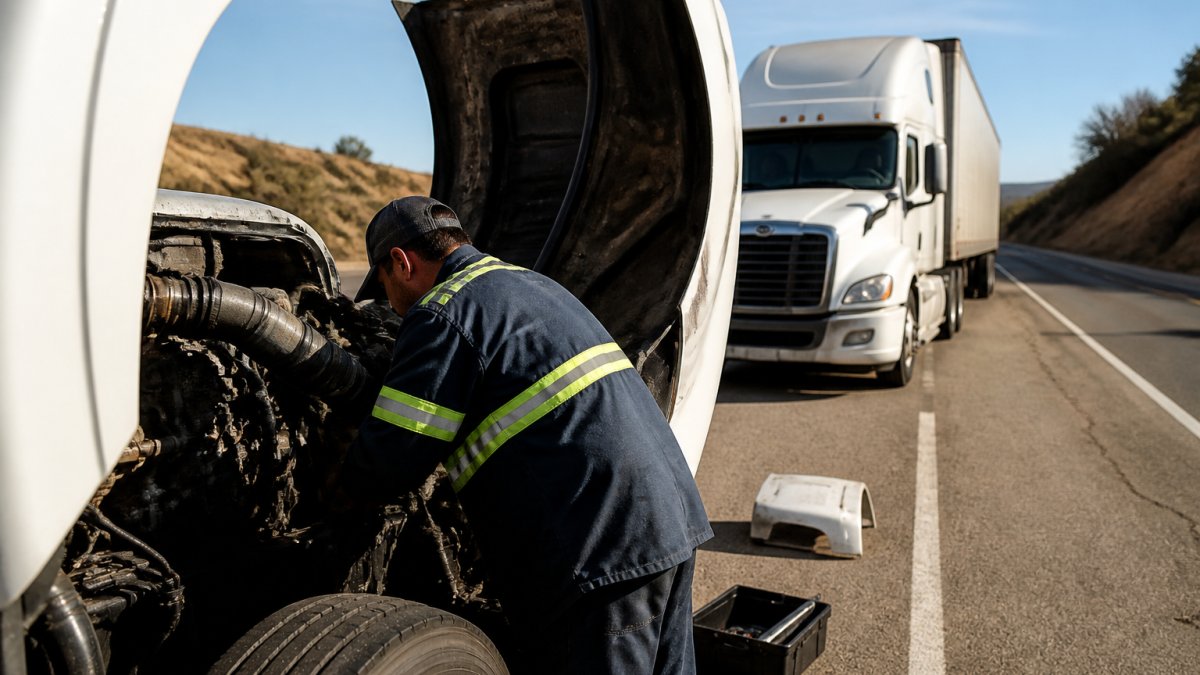
Emergency truck repair for owner operators is mostly about making good decisions quickly. Your priority is getting the truck and yourself out of harm's way, then getting accurate help on the way. A Federal Motor Carrier Safety Administration roadside safety guidance sets out the basic rules for warning devices and placement on the roadway, and those rules apply on every breakdown.
Here is the short version: get the truck off the travel lanes if you can, turn on your hazard lights, set out warning triangles, and stay clear of traffic. Then gather the details below before you make the call.
Safety Checklist for a Roadside Stop
Your first job is to keep yourself and anyone with you out of traffic. Work through this list before you touch the engine or leave the cab:
Move the truck as far onto the shoulder as safely possible, away from curves and hills where drivers can't see you.
Turn on the hazard lights and, if the truck is still in a lane, leave the engine running only long enough to steer off the road.
Set warning triangles or flares behind the truck at distances that give approaching drivers time to react, per your state's rules.
Put on a high-visibility vest before you exit the cab on the traffic side.
Exit on the side away from traffic, and stay behind the guardrail or outside the travel lanes whenever you can.
Keep passengers inside the cab if the shoulder is narrow.
A common mistake is opening the hood or checking tires while standing in the lane or on a narrow shoulder with no triangles set out. Get the warning devices in place first, then assess the problem.
Information to Have Ready Before You Call
Emergency truck repair goes faster when the technician can plan the trip before arriving. Have this information ready when you call:
Your exact location, including the highway, direction of travel, nearest exit, and mile marker. A landmark helps if the mile marker is hard to read.
Truck make, model, and year, plus the engine type.
A description of the symptoms: what happened, what you heard, smelled, or saw on the dash, and whether the truck can still move.
Any warning lights on the dash and any codes you have already pulled.
Whether the truck is loaded, and what it is carrying if you can say.
Your contact number and the name of your dispatcher or fleet manager, if one is involved.
Whether you need towing, and whether the trailer needs separate attention.
Write these details down before you call, because stress makes people forget the mile marker first. A photo of the dash warning lights or the mile marker can also save time.
Diagnosing the Problem by Symptom
Many breakdowns start with a symptom you can notice before the truck stops. Knowing the common patterns helps you describe the problem accurately and understand what the technician may check first. Treat these as clues, not conclusions.
Engine warning light or loss of power: Often points to fuel delivery, air intake, or sensor problems. Note whether the truck lost power gradually or all at once.
Brake smell, pulling, or air pressure dropping: Can indicate a brake or air system fault. Stop as soon as it is safe, because brake problems can worsen quickly.
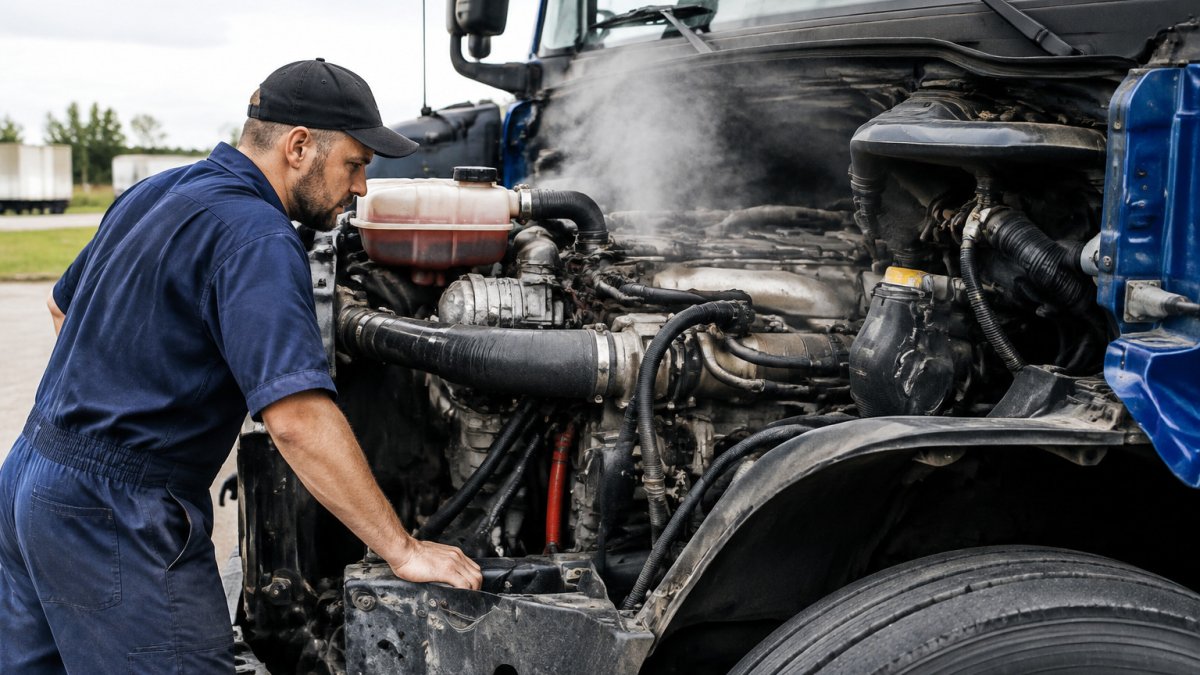
Overheating or coolant warning: May come from a cooling system leak, a failed fan or thermostat, or low coolant. Do not open a hot radiator cap.
Vibration, grinding, or a bad smell from the tires or axles: Suggests tire damage or drivetrain wear. Check whether the vibration changes with speed.
Electrical faults or a dead battery: Can come from the charging system, alternator, or wiring. Note whether the dash lit up and went out again.
Describe what you observed, not what you assume is wrong. "Power dropped under load and the check-engine light came on" gives a technician more to work with than "the engine is bad."
How to Prepare for a Truck Breakdown Before It Happens
Good preparation shortens every roadside repair. Keep a basic kit in the cab: warning triangles or flares, a high-visibility vest, a flashlight, gloves, a basic tool set, a tire gauge, and a first-aid kit. Store your current insurance, roadside assistance membership details, and maintenance records where you can reach them without digging through the trailer.

Keep a simple maintenance log of oil changes, brake inspections, tire rotations, and repairs. When a technician asks when the truck last had its coolant checked, a written answer helps them narrow the diagnosis faster.
Check the truck before you leave on a run. Walk around it, look at the tires and lights, check fluid levels, and watch the dash for warnings during the first few miles. Catching a small problem early is usually cheaper and safer than discovering it on a highway shoulder.
Save the number of a provider who serves your routes, and confirm whether they respond to your highway and state. Your fleet dispatcher may already have a preferred vendor, so ask before you need one.
Semi Truck Roadside Assistance Cost: What to Expect
Cost is the question most owner-operators ask first.
The service call fee typically covers the technician's travel to your location and is charged whether or not the truck can be repaired on the spot.
Factors that can affect the total include the factors below. Current pricing depends on the specifics of your call; contact Big Rig Repair directly for a quote.
Time of day. After-hours and weekend calls may be priced differently from daytime calls.
Location. Travel distance to your location can affect the call-out cost.
Whether the repair is mobile or shop-based. On-site repair and shop repair can be priced differently.
Parts availability. Sourcing a specific part can add time and cost.
Towing versus repair. Towing followed by shop repair and an on-site fix can cost different amounts depending on the failure.
Before work starts, ask for an itemized estimate in writing that separates the service call, diagnosis, labor rate, estimated hours, and parts.
Ask whether payment is due on completion, whether cards are accepted, and whether the provider works with any fleet or factoring payment arrangements. Keep every invoice, the itemized estimate, and photos of the failed part.
Watch out: a quote that is a single lump sum with no breakdown of labor and parts gives you no way to check the charges after the truck is fixed.
The article breaks a repair invoice into separate charges, which makes it easier to compare providers and check a bill.
Charge | What it covers | Note |
Service call or dispatch fee | Technician travel to your location | May be charged even if no repair is made on the spot |
Diagnostic time | Finding the cause of the failure | Often billed at a separate rate from repair labor |
Labor | Performing the repair | Ask for the rate and estimated hours in writing |
Parts | Components replaced during repair | Sourcing less common parts can add time and cost |
Towing | Moving the truck to a shop | Usually billed separately by the tow operator |
Choosing and Vetting an Emergency Repair Provider
When you need help fast, it is tempting to call the first number you find. A little checking can save money and frustration.
Credentials and insurance. Ask whether the provider carries commercial auto and general liability insurance and whether technicians hold relevant heavy-duty certifications.
Service radius and response time. Ask what highways and states the provider actually covers and what response time they quote for your location.
Mobile capability versus tow-only. Ask whether the provider can diagnose and repair on-site or will tow the truck to a shop.
Parts availability. Ask whether the technician carries common parts on the service truck and how long sourcing a less common part will take.
Estimate and billing practices. Ask for a written, itemized estimate before work begins and confirm how diagnostic time, service calls, and parts are billed.
Owner-operator experience. Ask whether the provider regularly works with owner-operators and small fleets, not only large carriers with accounts.
Commercial Truck Roadside Assistance Best Practices
Commercial trucks have demands that passenger vehicles do not. Downtime costs money, and every hour a load sits waiting can affect delivery schedules and customer relationships. These practices reduce the impact of a breakdown:
Keep your dispatcher informed from the first minute, with your location and estimated downtime.
Document the breakdown with photos of the truck, the location, and any warning lights.
Keep a written log of every call, technician name, and time of arrival.
Ask for a written summary of the repair, including parts replaced and any recommended follow-up.
Schedule preventive maintenance so fewer breakdowns happen in the first place.
For fleets, consider whether roadside assistance and preventive maintenance can be scheduled around your operating calendar. Repairs that can wait for a planned stop cost less than emergency work at night on a highway.
Booking Your Next Emergency Repair With Big Rig Repair
Big Rig Repair offers 24/7 heavy-duty truck repair and roadside service for owner-operators and fleets in the Sacramento area and Northern California. Our certified technicians use advanced diagnostics and focus on transparent communication and pricing, so you know what to expect at every stage.
If you have a breakdown now, call us with your location and the details from the checklist above. For planned maintenance or fleet service, contact Big Rig Repair to discuss scheduling.
Frequently Asked Questions
What should an owner operator do during a roadside breakdown?
Move the truck out of traffic if you can do so safely, turn on hazard lights, and set out warning triangles or flares at the proper distance behind the rig. Stay away from moving traffic and wait for help in the cab with your seatbelt on or outside on the far side from traffic. Then call for assistance and share your exact location, the mile marker or nearest exit, your truck details and a short description of the symptoms. Keep your logbook, load information and insurance details within reach so the technician or dispatcher can act quickly.
How much does emergency mobile truck repair cost?
Big Rig Repair has not published pricing data for this article, so no specific figures are given here. Costs depend on the type of problem, the time of day, the distance the technician travels and the parts involved. Contact Big Rig Repair directly for a current quote or a service estimate before the work begins, and ask how call-out fees and any charges for a service call that does not result in a completed repair are handled.
What are the most common roadside repairs for semi-trucks?
Flat or failed tires, electrical faults, battery and charging problems, air brake issues, fuel system trouble, cooling system leaks and starter failures are among the most frequent roadside calls. Many of these can be handled on site with the right parts and tools, while others, such as major engine or transmission failures, may require towing to a repair shop. Describing the symptoms clearly when you call helps the provider decide which kind of response is needed.
Is it better to call roadside assistance or a local repair shop?
Roadside assistance and mobile repair are usually the faster choice when the truck is stranded and can be safely reached, because the technician comes to you. A repair shop may be better when the truck can be driven to it and the problem needs a full bay, specialized equipment or a longer repair. Ask any provider whether they offer 24/7 dispatch, how they handle towing and whether they can work on your make and model.
Comments